Dear Fritz,
What a pleasure to gather in celebration of your birthday. Many happy returns! And thank you so much for giving us this excuse, this opportunity to write. No irony intended. The incentive of the occasion, for me, has been to take a good look at some of Joyce's early drafts for Ulysses. Pondering what might entertain you on your birthday, I thought how pleasant it would be to take you on an observation tour round some of those early, pre-Rosenbach documents - and which would be more appropriate than the drafts for "Nausicaa." You have, I suppose, held them in your hands, and spent some time over them on one occasion or another: those three copy-books - one at Buffalo (V.A.10) and two at Cornell (56A and B) - that contain consecutively the entire first drafting of the episode (your episode in the Hart and Hayman volume of essays on Ulysses, staunch companion to every close reader). The opening, at the very least, may have caught your attention, that brilliant example of "composition of place" (U 9.163) in actual Joycean writing practice:
The
mild mysterious
     mysterious
     summer

evening had begun to

wrap
fold

all nature in its

soft    mysterious glow.
mi deep mysterious glow.
   deep mysterious warmth.

Faraway in the west the sun was setting and the last

light of                  day, veiled and
glow  of                  day,
glow  of all too fleeting day,

shone
lingered

softly upon the sea and strand, on the proud

promontory,                 old Howth, the
promontory of dear faithful old Howth,

guarding as ever the waters of the bay, on the old

weedgrown rocks
weedgrown rocks along Sandymount shore

and
and, last but not least,

on the quiet church whence

music and
music of worship
music of prayer

streamed forth at times upon the

stillness
stillness,

worship to her who is, in the her pure radiance,

a beacon ever to the stormtossed

heart,
heart of man,

Mary, star of the sea.
Phrase by phrase, the paragraph grows into shape. Joyce works on it
much like a potter molding his pot and occasionally snipping off bits of
clay in one place only to lay them on and knead them in again in
another. The very opening words, for instance, start off with a bit too
much laid on, so 'mild mysterious' loses the 'mild' (his diagonal
strike-out indicates an in-writing deletion). At the end of the first
sentence, 'mysterious' is the word that comes to pen a second time. In
this position, its effect is climactic. Hence it is removed from the
beginning and there replaced by a neutral 'summer'. The new
'mysterious', in its turn, appears to irk for some other qualifier than
'soft'. With an incipient 'mi', it almost again
attracts 'mild', but the phrasing then temporarily settles for 'deep
mysterious glow.' Yet a little later in the writing process, the most
appropriate place for the word 'glow' is found in the second sentence in
response to the phrase 'the last light of day' as initially written. So
'warmth' goes to replace 'glow' to end the first sentence. For 'the last
light of day,' a clause in apposition - veiled and -
is begun but abandoned. The 'last light/glow of day' now steers directly
for its verb, for which the qualifier 'soft', just having given way to
'deep' above, is retrieved as the apposite adverb: 'softly'. It holds
out even as the verb changes from 'shone' to 'lingered'.
'Lingered' signals a tone of cliché and sentiment subsequently
reinforced by the phrases 'all too fleeting', 'of dear faithful' and
', last but not least,' (thus written and punctuated in the margin). The
composition of place acquires topographic specificity with the
weaving-in of 'along Sandymount shore'. How resonantly to end the second
sentence briefly gives pause. The attempted 'music and'
is changed to 'music of worship'. The peroration then gathers momentum
when the music becomes 'music of prayer' and 'worship' is moved forward
through the marking of a redirection in the course of the writing
itself: "worship to her ... a beacon ever ... Mary". At the core of the
articulated phrasing is 'the stormtossed heart'. The revision at last
of 'heart' to 'heart of man' finally establishes at the end of this
opening paragraph the fundamental (man:Mary, man:woman, Bloom:Gerty)
opposition for, and of, the "Nausicaa" episode.
Thus the writing gets into stride. Paragraph after paragraph fills the right-hand columns of the copy-book pages. This is how Joyce lays out his working space on paper. The consecutive movement of the writing basically carries forward down the right-hand recto columns. This leaves on every page an ample margin for changes and additions beyond such brief ones as can be fitted between the lines. The margins tend to widen as the main columns shrink towards the right down each page. The left-hand pages of each opening - the versos of the preceding leaves - are always initially left blank. They are the overflow areas for additions and extensions that cannot be accommodated either interlinearly or in the margins alongside the main right-hand columns. In its final state as we see it before us - when Joyce has gone over the writing and altered and augmented the text many a time - an opening often enough looks heavily cluttered. Rarely, however, is it uncertain whence, in the main column, a word or phrase out there in the spaces of margin and facing verso springs, or where, in the main column's ideal linearity of progression, it is is meant to go. An elaborate linking - Joyce's arbitrary system of 'hypertext marks': caret, 'F', 'A', 'B', 'M', 'S', 'W' etc. - ensures the intended coordination.
The draft links organize the discrete acts of writing in the draft into an intended reading sequence and so indicate a consecutive text suitable, say, to be copied into another document. The reading sequence leaves the writing sequences behind that the draft document itself uniquely bears witness to and challenges us to explore. Their essential characteristic is that they are non-linear and non-consecutive. The spatial distribution of main-column text and arbitrarily scattered revisional matter - page and leaf by page and leaf, as well as over each copy-book opening - bears a relation to the temporal stages of the writing. The question - and hence the challenge - is how closely that relation is determinable. From Joyce's drafts, the writing sequences cannot on the whole be exhaustively established, nor demonstrated in every detail. Entries in the margin and on the facing verso are later than the main-column text, yes; but whether later than the main column one paragraph, or a page or two, onwards, is uncertain. The relative timing of the revisional units in their turn is occasionally obvious from sub-linkings. In general, however - and despite observable differences in the handwriting or the writing implement - it remains elusive.
The opening paragraph of "Nausicaa" is exceptional in the way it allows us to catch the interplay of writing and revision in one continuous act of composition. As the drafting of the chapter progresses, jugglings of words and phrases forward and backward, or halts in mid-phrase with fresh starts of construction, become less frequent. Surveying the pages consecutively just down the main columns as initially put to paper, one soon discerns that paragraphs, individually or in consecutive groups, were commonly Joyce's inscriptional units. If the hand changes, it is usually from one paragraph to the next; alternatively, or in addition, a new paragraph moves distinctly further left, recovering margin space that the previous one had gradually ceded. Many of such division points may indicate a break - say, for a rest, a meal, a social engagement, or at the end of a working day. Others may indeed have been occasioned by a desire to go back and revise. There can hence be no telling what, and how much, revision at any given point went into text already written before subsequent composition resumed. What we can observe is the concentrated flow of many paragraphs as first, with apparent ease, put to paper. The breaks and pauses we infer may therefore also indicate that paragraphs were carefully worded in Joyce's head before he wrote them out. Sometimes the result drew little or no subsequent revision. Interestingly, this, in the "Nausicaa" draft, is true especially for several of the hymnic passages narrating the proceedings in St. Mary's church. More often, however, the main column initially received but functional outline sketches, rapidly written, that then were considerably changed and augmented in the margin and on the facing versos.
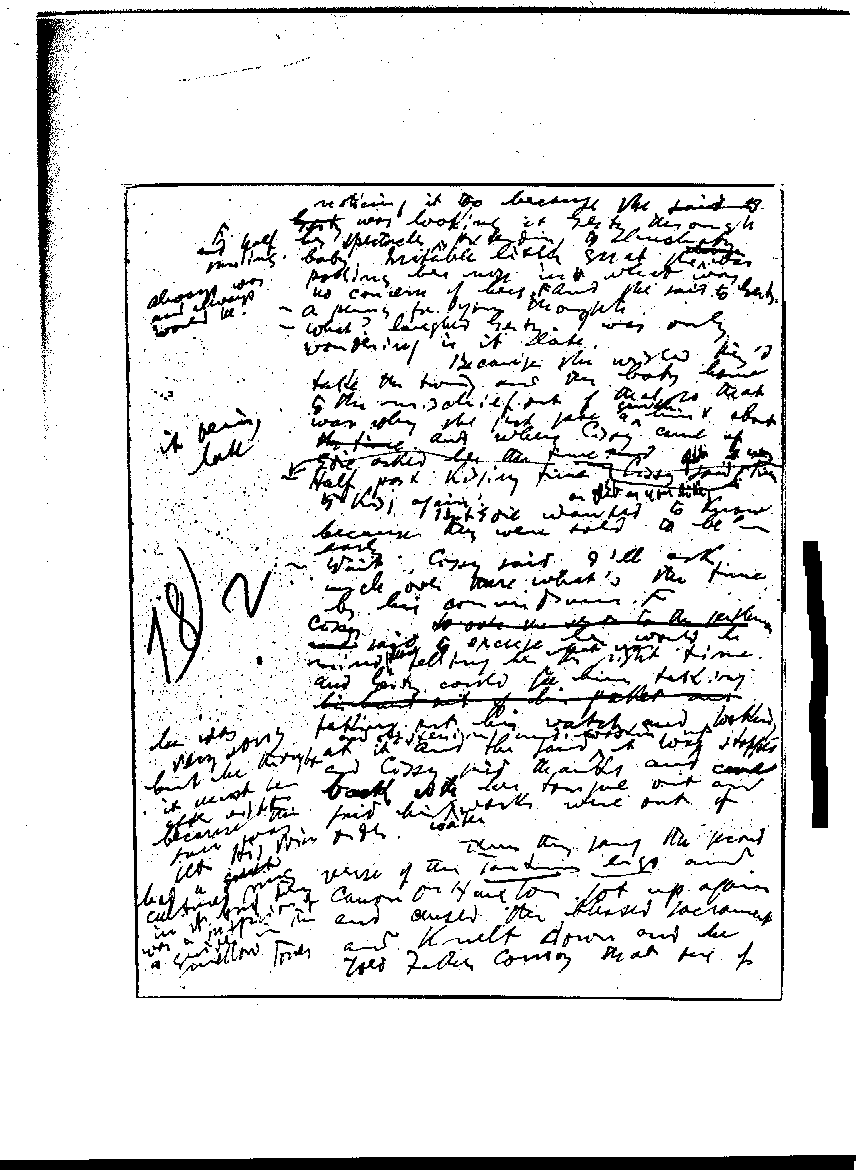
Draft page 18 with 17 verso (in V.A.10) provides an instructive example. Half-way down page 18, two consecutive units of inscription in the main column rapidly outline the moment when Cissy Caffrey walks over to Bloom to ask him what time it is.
                        -- Wait, Cissy said. I'll ask
                        uncle over there what's the time
                        by his conundrum.
                           So over she went to the gentleman
                        and said to excuse her would he
                        mind telling her the right time.
                        And Gerty could see him taking
                        his hand out of his pocket and
                        taking out his watch and looking
                        at it. And he said it was stopped
                        and Cissy said thanks and came
                        back with her tongue out and
                        said his works were out of
                        order.
The actual appearance of main column and margin however is as follows:
                        -- Wait, Cissy said. I'll ask
                        uncle over there what's the time
                        by his conundrum. F
                ?        So over she went to the gentleman
                        Cissy
                        and said to excuse her would he
                            please     what was
                        mind ^ telling her ^ the right time.
                        And Gerty could see him taking
                        his hand out of his pocket and
  he was                taking out his watch and looking
   very sorry             and listening and looking up
  but he thought        at it. And he said ^ it was stopped
  it must be            and Cissy said thanks and came
  after eight           back with her tongue out and
  because the           said his ^ works were out of
  sun was                       water
  set. His voice        order.
had a quiet
cultured ring
in it, but there
was a suspicion of
a quiver in the
         mellow
                tones
Conceivably the additions between the lines careted in - 'please', 'what was', 'water' - as well as the interlined phrase 'and listening and looking up' represent a first level of revision. The level also extends to the marginal addition. No mark of insertion is given for 'and listening and looking up'. Relative placing alone suggests that it may be intended to go in after 'at it'. For the caret that is present in the line most likely refers to the addition in the margin. The margin text itself presents us with a choice of whether to read it as one continuous passage, or else as two segments. The caret at 'said' most readily indicates a place for 'he was very sorry' - 'he said +he was very sorry+* it was stopped'. (The four words would have fitted between the lines but for the presence there already of 'and listening and looking up'.) The rest of the marginal addition, then, would follow on from 'stopped'. But once more we find no explicit direction and have only the relative placing to go on. It is this combination, however, of either carets only or else no explicit mark of insertion that makes us confidently group this set of changes together as one - the first - level of revision.
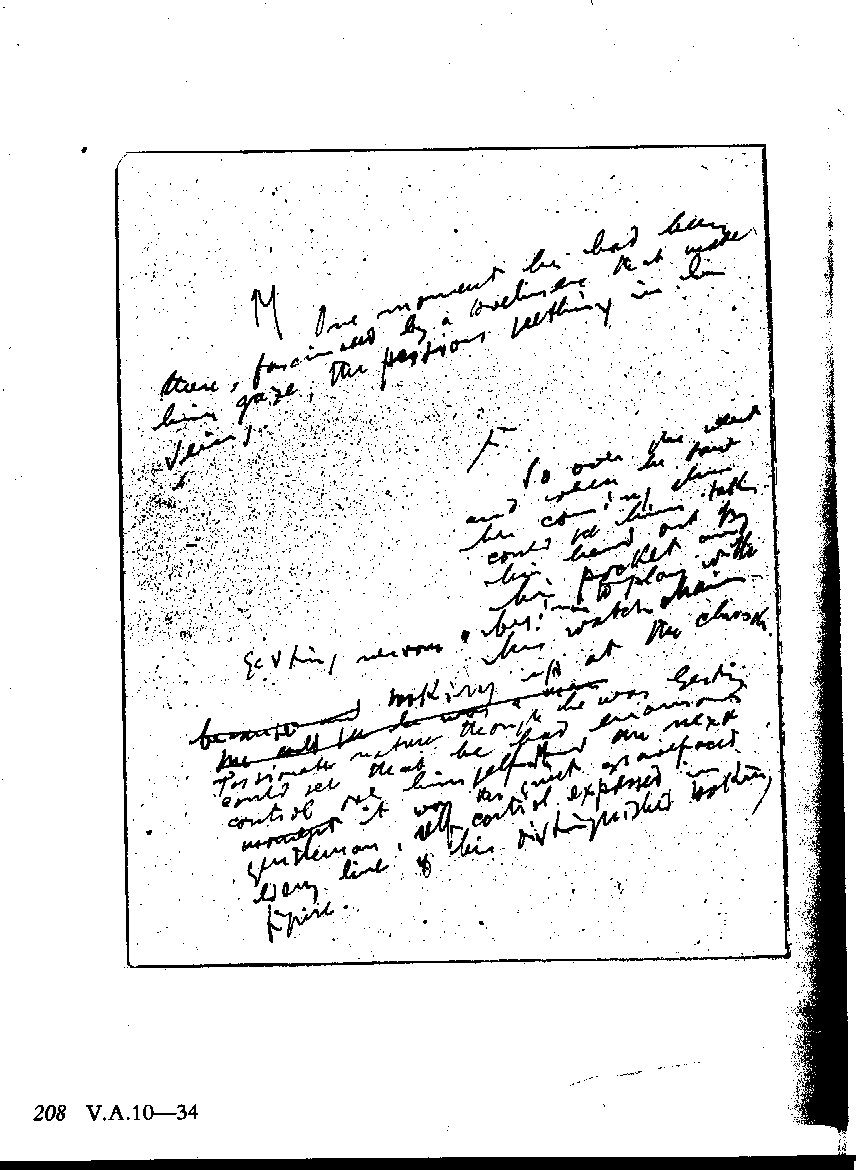
The second level is, we can take it, signalled by the question mark in the margin - Joyce's reminder to himself, perhaps, that the passage would need yet more done to it. The further revision is initiated by the striking out of two lines of text. This becomes clear from the way these are worked in again into the extension on the facing verso. The extension is keyed in with an 'F' to the main column, and 'Cissy' over deleted 'and' marks the point of re-entry. The facing-verso text is composed in three phases. The third phase runs diagonally across the page top. It is 'M'-keyed into the middle of the second phase, which covers the width of the lower third of the page. The 'F'-keyed narrow right-hand column at about mid-page constitutes the first phase, i.e., the beginning of the extension. Some hesitation at the joint between first and second phase is marked by three separate strikings-out as, at the same time, the writing moves fully over to the left. This is how the facing-verso page looks:
          M
             One moment he had been
there, fascinated by a loveliness that made
him gaze, the passions seething in his
veins.


                         F
                            So over she went
                         and when he saw
                         her coming she
                         could see him taking
                         his hand out of
                         his pocket and
       getting nervous & beginin to play with
                         his watch chain
because and        looking  up at the church.
She could see he was a man
Passionate nature though he was Gerty
could see that he had enormous
control over himself . M and the next
moment it was the quiet gravefaced
gentleman, self control expressed in
every line of his distinguished looking
figure.
Thus, the disposition of the draft text on pages 18 and facing 17 verso exemplifies beautifully how disjunct writing sequences work towards a reading sequence whose very force and tension derives from the conjunction into linearity of the non-consecutive phases of the creation. The compositional result moves forward in the manuscript transmission, first into a final working draft, we presume, and thence to the Rosenbach fair copy. There it arrives with minor adjustments, and notably a paragraph break. The phrase 'and listenening and looking up' was not with impunity left without a mark of insertion in the draft. Joyce as copyist appears to have overlooked it and is seen to re-enter it in the fair-copy margin, positioning it somewhat differently from what we believed was his earlier intention. Here, in parallel, are the compositional result of the draft and the adjusted version in the Rosenbach fair copy:
-- Wait, Cissy said,		-- Wait, Cissy said,
I'll ask uncle over 		I'll ask uncle Peter over
there what's the time by his 	there what's the time by his
conundrum.			conundrum.
   So over she went 		   So over she went
and when he saw her coming		and when he saw her coming
she could see him taking his	she could see him take his
hand out of his pocket and 		hand out of his pocket,
getting nervous & begin to		getting nervous and beginning to
play with his watch chain 		play with his watch chain,
looking up at the church.		looking up at the church.
Passionate nature though he 	Passionate nature though he
was Gerty could see that he		was Gerty could see that he
had enormous control over		had enormous control over
himself. One moment he had 		himself. One moment he had
been there, fascinated by a 	been there, fascinated by a
loveliness that made him 		loveliness that made him
gaze, the passions seething 	gaze, the passion seething
in his veins. and the next 		in his veins and the next moment
it was the quiet gravefaced 	it was the quiet gravefaced
gentleman, self control 		gentleman, selfcontrol
expressed in every line of his 	expressed in every line of his
distinguished looking figure. 	distinguished looking figure.
Cissy said to excuse		  Cissy said to excuse
her would he mind please 		her would he mind please
telling her what was the 		telling her what was the
right time. And Gerty could 	right time and Gerty could
see him taking taking out 		see him taking out
his watch and looking at it 	his watch and listening and
and listening and looking up. 	looking up and looking at it.
And he said he was very sorry 	And he said he was very sorry
it was stopped but 		his watch was stopped but
he thought it must be after 	he thought it must be after
eight because the sun was 		eight because the sun was
set. His voice had a 		set. His voice had a
cultured ring in it, and 		cultured ring in it and
there was a suspicion of a 		there was a suspicion of a
quiver in the mellow tones 		quiver in the mellow tones,
and Cissy said thanks and 		and Cissy said thanks and
came back with her tongue 		came back with her tongue
out and said his water works 	out and said his waterworks
were out of order. 		were out of order.
With a little familiarity gained of the ways in which the draft
unfolds, we may just glance cursorily down the margins and facing versos
to find there a multitude of the gems of phrasing that so endear the
"Nausicaa" episode to us: 'No spoilt beauty was she.' and 'No truer
Caffrey ever breathed', on draft pages 1v and 2, or 'The
waxen pallor of her face was almost spiritual in its ivorylike purity.'
on draft page 3v; 'Inclination prompted her to speak out:
dignity told her to be silent.' on page 4v, and '(though
Gerty was a little more would never see 17 again)' on
page 6; 'and there was meaning in his look' on page 13, or 'if they
could run like rossies she could sit' on page 22; 'what an utter cad he
had been?', even 'Tight boots. NO! She's lame. +O!+* Pth!' on pages 24
and 24v; and 'that brought thee us out of
the land of Egypt and into the house of bondage' and '...Do fish get
seasick?' on pages 31v and 32. At least one revisional
addition is almost demonstrably an entry made on completion of the
entire draft: '... or a clock but they had a clock with a canary in it
to tell the time +on the mantelpiece+* in the priest's house that day
Saturday when she went for the priest for Mr Dignam' on page
14v would seem an extension worked late into Gerty's musings
to prepare for the cuckoo-clock conclusion to the chapter as written. In
its turn, the actual nine-fold sounding of the clock at the end looks,
from the evidence of the writing on draft page 35, as an inspiration of
the moment. The first triple 'Cuckoo' peal goes in to replace a
narrative paragraph commencing with 'The clock', but
abandoned in mid-phrase and taken up again only after the peal.
In pursuit of such individual gleanings, we also discover, with no
little astonishment, that "that book The Lamplighter
by Miss Cummins" (U 13.633) was not in "Nausicaa" right from
the start. On draft page 21, the opening leaf in Cornell 56A, the first
inscription runs as follows: "... and she could see far away the
lights of lighthouses and soon the lamplighter would be going his rounds
like she read in that book by Mrs Gaskell, and she wa
For Gerty had her dreams that no-one knew of." The abandoning of a
construction and replacing it by a new sentence is one of the meanwhile
rarer occasions of changing course in mid-phrase. Over 'and she
wa' as deleted in ink, we find 'The Lamplighter' inserted, also
in ink, between the lines. When exactly it was so inserted is difficult
to determine. 'Gaskell', it is true, is cancelled in its turn, but in
pencil, and thus not simultaneously with the interlining of 'The
Lamplighter'; "that book by Mrs Gaskell, The Lamplighter" is therefore a
possible temporary textual solution, however preposterous. The pencil
striking out 'Gaskell' also writes 'Cummins' into the margin close
by. But this may be in consequence only of some curious fumbling, partly
in ink and partly in pencil, further down in the margin. There (first,
we presume) in ink, we find "author of Ruth etc" - Mrs Gaskell, that
is, being still adhered to. 'Ruth' and 'etc' are subsequently struck out
separately, and with the same pencil that deletes 'Gaskell'; then, above
'author of' (in ink) left standing, we find penciled the sequence "Mabel
Cummins Vaughan & other tales". Both 'author of' and
'Mabel Cummins Vaughan & other tales' remain undeleted,
but their intended use and placement is not indicated. We may imagine a
set of alternative, albeit all dubious, options for a final phrasing,
e.g., ?Mrs Gaskell, The Lamplighter :: ?Mrs Gaskell, author
of Ruth etc :: ?Mrs Gaskell, author of The Lamplighter ::
?Mrs Cummins, The Lamplighter author of Mabel Vaughan and other
tales :: ?Mrs Cummins, The Lamplighter. Conceivably, no
more was intended than to replace the 'Mrs Gaskell, The Lamplighter' by
a 'Mrs Cummins, The Lamplighter'. But, with the undeleted phrases
dangling in the margin and the matter thus unresolved in the draft
itself, the wording in the Rosenbach fair copy comes out, blurb-like, as
"...like she read in that book The Lamplighter by Miss
Cummins author of Mabel Vaughan and other tales." What
is intriguing is finally not so much the textual conundrum. Seeing what
trouble Miss Cummins had of getting into the text at all, it is, rather,
the implicit warning not to lean too heavily on the Cummins intertextual
reference for the stylistics of the Gerty MacDowell section of
"Nausicaa."
That the basic draft text was put to paper paragraph by paragraph in firm initial outline marks a perceptible distance between the act of invention in Joyce's head and the act, and acts, of writing. What the wealth of marginal and facing-verso revisions indicates, however, is that the composition as a whole received an enormous increased stimulus from the text manifest on paper. The draft page itself becomes the site where invention and writing come together. If such coincidence was fleetingly observable in the drafting of the episode's opening paragraph, the "Nausicaa" draft also holds in store one page and leaf that differs from all others in that it bears witness of Joycean invention and composition as an immediate writing event. This occurs as Bloom's reflections are stimulated by a waft of Gerty MacDowell's perfume. Commencing at notebook Cornell 56A, last paragraph on page 28, we read:
   Wait. Hm. Hm. Yes. That's
her perfume. Why she took out her
handkerchief to wave it. I leave
you this to think of me +when I'm far on the pillow+*. What
is it? Heliotrope? No. +<New Mown
Hay> Hyacinth+*? Hm. Roses, I think. She'd
like scent of that kind. Sweet
and cheap: soon sour. Why Molly
likes opoponax. Suits her. With
a little jessamine mixed.
[Here and below - as on a couple of occasions already above -
 '+....+*' encloses revisional changes, one '+' for every level;
 '<....>' marks a deletion.]
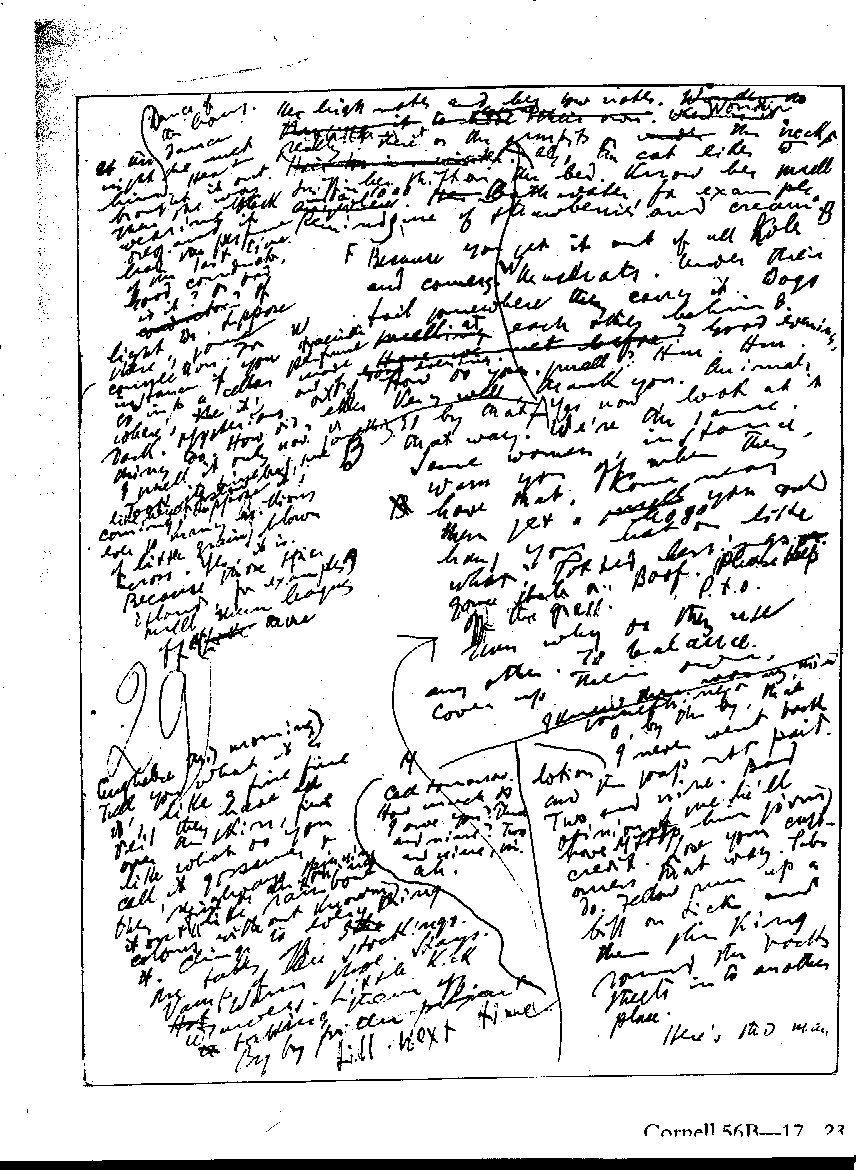
This ends one notebook, and Joyce takes a fresh one - Cornell 56B - entering on its first blank page first (for which we give evidence below) the pagination '29)'. Then he continues:
Her high notes and her low notes. Wonder do
they use it to hide their own. Where is it,
really? There or the armpits or under the neck.
Hair too in winter. Also the cat likes to
sniff >in< her shift<.> on the bed. Know her smell
anywhere. Her bathwater, for example.
Reminds me of strawberries and cream.
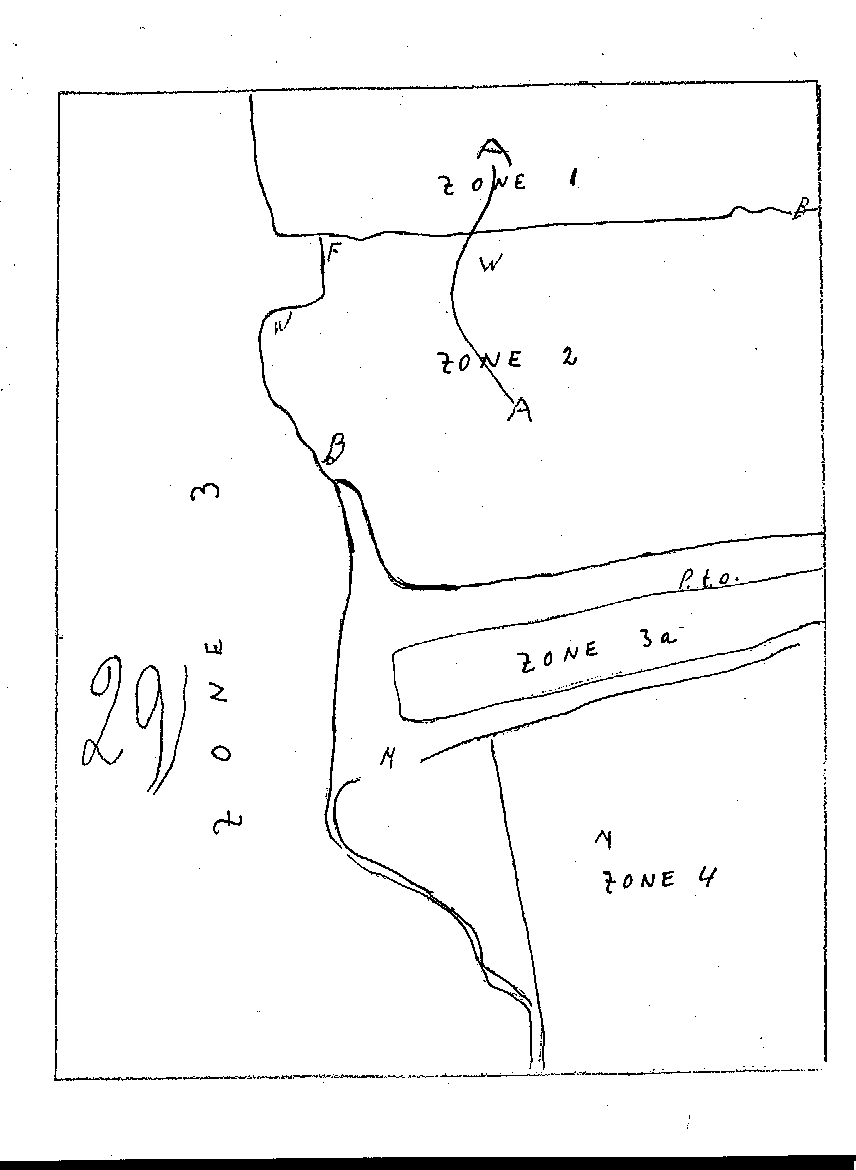
Seven lines: let us call them Zone 1 (click here for zonal map). The page is still largely blank, but the writing does not flow uninterrupted into line 8. There is a perceptible pause and a resumption - not a new paragraph - that appears to follow from a going-back over the seven lines written. The impulse to continue comes from "Where is it, really? There or the armpits or under the neck.", and specifically from the notion 'under'. The word is struck out. If indeed deleted at this moment, it is to make room for images freshly crowding in. Corresponding 'F' markings key line 8 to 'neck.'
Because you get it out of all <c> holes
and corners. Muskrats. Under their
tail somewhere they carry it. Dogs
smelling each other behind.
Have we met before? Good evening,
how do you smell? Hm. Hm.
Very well, thank you. Animals
go by that. Yes now, look at it
that way. We're the same.
Some women, instance,
warn you off when they
have that. Come near
them get a smell you could
hang your hat on like what?
Potted herrings or.
Extending over fifteen lines, this apparently represents the second movement in the writing: Zone 2. It carries forward in one sweep, yet is structured dialogically and so divides potentially (as it soon will actually divide) at "Yes now, look at it that way." The first of the zone 2 segments enlarges upon "Also the cat likes to sniff in her shift on the bed." from zone 1, establishes from it a series ('cats') - 'muskrats' - 'dogs', and summarizes this in 'Animals go by that.' The dialogic answer - 'look at it that way' - is 'We're the same.', which, with an increasing speed of the hand (the words sprawl, and their number per line decreases), becomes exemplified in the smell from women 'when they have that.'
The second writing pause on the page, at 'herrings or.', leads to a reconsideration of the order of the composition so far achieved. The second half of the zone 1 segment - from 'Also the cat' onwards, which was what originally engendered the zone 2 section - is repositioned to follow 'Animals go by that.' (by the corresponding marking letters 'A'), that is, at the dialogue divide of zone 2. As it is so repositioned, it is, let us assume, slightly revised in the process: 'her smell anywhere' becomes 'her smell in a 1000', 'Her bathwater' becomes 'Bathwater'; or corrected: at 'Reminds' the concluding 's' is either clarified, or, if earlier forgotten, is added with a flourish. Between the 'F' divider at 'neck.' in zone 1 and the upper of the two 'A's splicing 'Also the cat' into the middle of zone 2, the sentence "Hair too in winter.", having lost context in both directions, is deleted. A double 'B' marking furthermore ensures that 'Yes now,' of zone 2 joins on to 'strawberries and cream.' of zone 1. With such merging of the zones accomplished, the tight dialogicity of zone 2 as originally composed is weakened, if not sacrificed. Bloom's train of thought, instead - as is its wont - starts to unfold in more richly associative ways.
For his next cue, I take it, Joyce once more loops back to the top of the page, to the sentence "Her high notes and her low notes." As written, it was a somewhat quirky linking phrase between 'Why Molly likes opoponax. Suits her. With a little jessamine mixed.' (i.e., the concluding sentences on page 28) and 'Wonder do they use it to hide their own.' The fact that the page break shades off the continuity appears to have facilitated, now, a reading response to 'Her high notes and her low notes' in isolation. What this engenders is the Zone 3 writing which carries rapidly down the entire left-hand margin of the leaf [jumping over the page numbering '29)'; hence the likelihood that this numbering was the first inscription on the blank page]. Sparking off the text column in the left margin is a Molly-related association of music and dance. Very soon, however, this becomes again infused with a complexity of smells, the leading motif of the passage. Additionally, the zone 3 writing achieves a notable density of Bloomian recalls from earlier Ulysses episodes, and we get:
At the dance
night she met
him.]+[ Heat			 +Dance of the hours.+*
brought it out.
Then she was
wearing ]+[ black 			 +her+*
dress and it
had the perfume
of the last time.
Good conductor,
is it? Or bad
<conductor>? Of
light too. Suppose
there's some
connection. For
instance if you
go into a cellar
where's <the> it's
dark. Mysterious
thing too. How did
I smell it only now?
Took its time
coming]+[. Suppose it's		 +, like herself, slow but sure+*
ever so many millions
of little grains blown
across. Yes, it is.
Because those spice
islands, for example]+[,		 +those Cinghalese this morning+*
smell them leagues
off. (<Like> those			 [marked for repositioning above]
Cinghalese this morning.)
Tell you what it is
it's like a fine fine
veil they have all
over the skin, fine
like what do you
call it gossamer &
they're always spinning
it out ]+[ like rainbow		 +fine as anything+*
colours without knowing
it. Clings to every thing
she takes off. <S> <The>
Vamp of her stockings.
<Hot> Warm shoe. Stays.
Drawers. Little kick
<to take> taking them off.
By by for the present
At this point, the left-margin column - zone 3 - hits the bottom of the page: time, we may assume, to consider whether this burst of writing joins well at the interstice whence it gushed. The sentence "Wonder do they use it to hide their own." apparently first receives the revision '+<hide> cover up+*', but is on second thoughts reconsidered altogether. The revised sentence is deleted and replaced by a rephrased transition:
Then why do they use
any other. To balance.
Cover up their own.
If not too elegant, perhaps, nor too compelling, this brief passage functions as a switch back into the groove of the reorganised zone 1 / zone 2 text that is now to be read as continuing on from the zone 3 section. With the margin exhausted, the transition, joined on to zone 3 by an arrow, is entered below the end of zone 2, that is, into the right-hand main column of the manuscript page. Let us call the area Zone 3a. The right-hand page column is, before entry of the zone 3a transitional sentences, still about one-third empty. Joyce leaves ample space between zones 2 and 3a (which soon, however, he will crowd). The composition of the transition is effected with customary economy in the re-use of phrases or part-phrases. This, after the deletion of "Wonder do they use it to cover up their own.", carries over also into the adjoining sentence - third in zone 1 - into which the word 'Wonder' is moved by revision.
Read over in continuity so far as accomplished for the present, the passage may have been touched up by the revisions and additions to the zone 3 text indicated above. Revision also goes into the text of zone 2. An addition, "Hyacinth perfume made out of ether or something." (marked 'W'), is keyed in to follow 'holes and corners.' Crowded in as it is between zones 3 and 2, it clearly postdates the writing of zone 3 and is likely to have been entered at this juncture. Interestingly, it matches the marginal 'Hyacinth?', replacing 'New Mown Hay?', on the preceding manuscript page. This phase in the text's progression thus appears concerned with a fine-tuning of perfumes, and we should probably also allocate to it the zone 2 change from 'Dogs smelling each other behind. Have we met before? Good evening, how do you smell?' to 'Dogs at each other behind. Good evening, <Good> evening. How do you smell?', as well as the sharpening of the 'smell you could hang your hat on' to 'hogo you could hang your hat on'. A frizzle in the pen, furthermore, shows that the replacement at the bottom of the zone 3 column of 'for the present' by 'till next time' coincided with the addition to the zone 2 text. Its conclusion 'herrings or.' is extended to read 'herrings gone stale or. Boof. Please keep off the grass.' This extension now fills the space at first left empty above zone 3a.
The dispositioning of spaces - zones - on the page and the splicing and refitting of segments of text that we have traced so far has yielded a continuous passage which, with the revisions incorporated, reads as follows:
Her high notes and her low notes. At the dance night she met
him. Dance of the hours. Heat brought it out. Then she was
wearing her black dress and it had the perfume of the last
time. Good conductor, is it? Or bad? Of light too. Suppose
there's some connection. For instance if you go into a
cellar where's it's dark. Mysterious thing too. How did I
smell it only now? Took its time coming, like herself, slow
but sure.  Suppose it's ever so many millions of little
grains blown across. Yes, it is. Because those spice
islands, for example those Cinghalese this morning, smell
them leagues off. Tell you what it is it's like a fine fine
veil they have all over the skin, fine like what do you call
it gossamer & they're always spinning it out fine as
anything like rainbow colours without knowing it. Clings to
every thing she takes off. Vamp of her stockings. Warm
shoe. Stays. Drawers. Little kick taking them off. By by
till next time. Then why do they use any other. To
balance. Cover up their own. Wonder where is it really?
There or the armpits or the neck. Because you get it out of
all holes and corners. Hyacinth perfume made out of oil of
ether or something. Muskrats. Under their tail somewhere
they carry it.  Dogs at each other behind. Good evening,
evening. How do you smell? Hm. Hm. Very well, thank
you. Animals go by that. Also the cat likes to sniff in her
shift on the bed. Know her smell in a 1000. Bathwater, for
example. Reminds me of strawberries and cream. Yes now, look
at it that way. We're the same. Some women, instance, warn
you off when they have that. Come near them get a hogo you
could hang your hat on like what?  Potted herrings gone
stale or. Boof. Please keep off the grass.
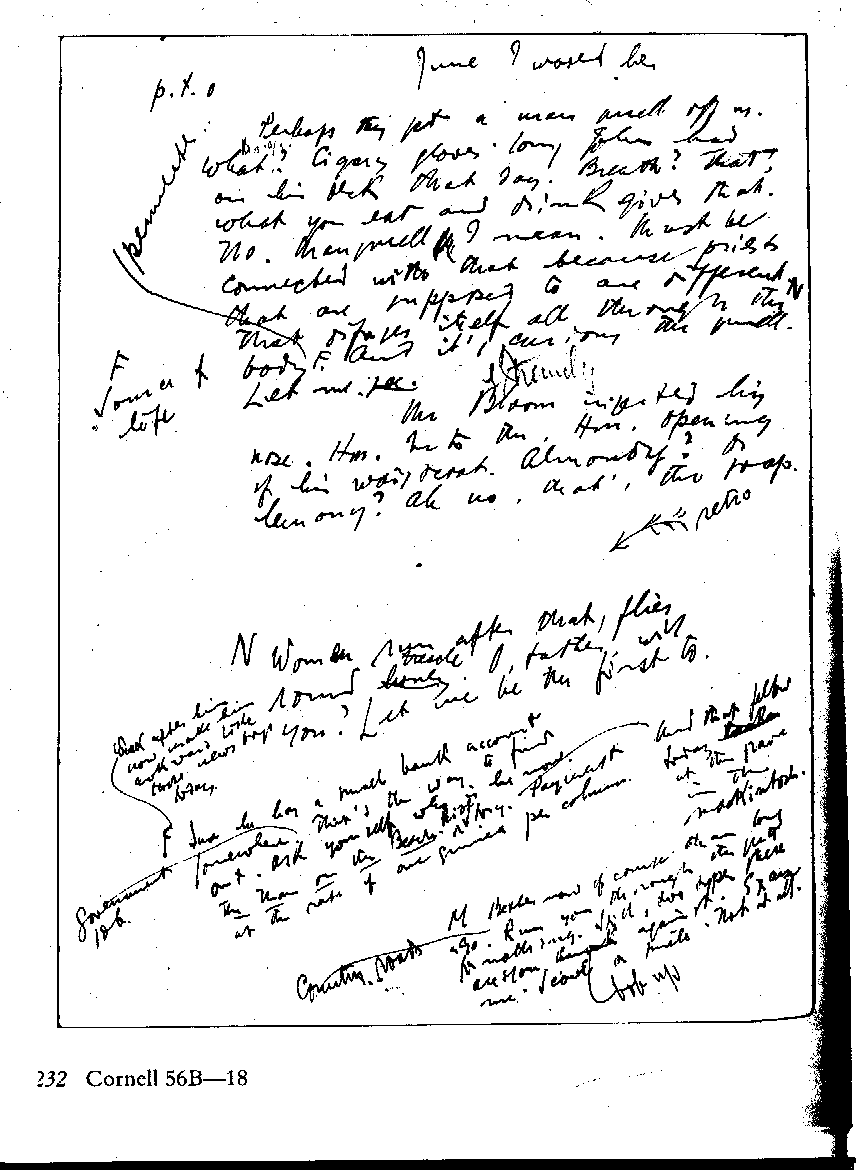
Then, to the right of 'off the grass.', we find a direction "P.t.o.", and on the verso of the leaf a conclusion to this rhapsody on smells. It consists of two main paragraphs, themselves in turn surrounded with additional changes and extensions. An elaborate arrow labelled "retro" directs us back to the recto of the leaf. It leads to the boxed-in lower right-hand quarter of page 29 - Zone 4. The textual sequence is inevitable.
Yet in terms of the draft organisation, the situation is curious. For it must be visualised that, with zones 1 to 3a filled, zone 4 on page 29 was still blank. Was it still so blank when the "P.t.o." section on 29 verso was composed? If so, what prevented its use for what is now the conclusion to the olfactory passage? Or was, on the contrary, the boxed-in text written before that conclusion?
The boxed-in section extends to one paragraph plus the three opening words of a second that then continues regularly on page 30. As written and revised - that is, with the incorporation of one addition straddling the upper separating line, and of a further extension squeezed into a cone of space between zones 3 and 4 and carefully roped in to go with the boxed-in text by yet a squiggly line of separation - the zone 4 text reads as follows:
   O, by the by, that lotion. +I knew there was something on
my mind+* I never went back and the soap not paid. Two and
nine.  Bad opinion of me he'll have. +Call tomorrow. How
much do I owe you? Three and nine? Two and nine, sir. Ah.+*
+xxxx+* Stop him giving credit. Lose your customers that
way. Pubs do. Fellow run up a bill on tick and then slinking
round the backs streets into another place.
   Here's this man
This is a fresh opening with little or no manifest connection to the preceding sequence ending - if provisionally - at "Potted herrings gone stale or. Boof. Please keep off the grass." It is only the "P.t.o" section that establishes the explicit narrative link:
   Perhaps they get a man smell off us. What +though+*?
Cigary gloves long John had on his desk that day. Breath?
That's what you eat and drink gives that. No. Mansmell
<^> I mean. Must be connected with that
because priests that are supposed to are different. +Women
run after that, flies round ++<honey> treacle++*. O,
father, will you? Let me be the first to.+* That diffuses
itself all through the body +permeates.+* +Source of
life+*. And it's +extremely+* curious the smell. Let +<me
see.> me.+*

   Mr Bloom inserted his nose. Hm. Into the. Hm. Opening of
his waistcoat. Almond<s>y? Or lemony? Ah no, that's the
soap.
Progressing - still within the olfactory - in a boisterous leap from the hogo of women to the mansmell of priests, the section culminates in a Bloomian self-experiment. The surprise whiff of lemon soap from inside Bloom's waistcoat wafts away the odour of hyacinth and with it all the imaginary smells to which Gerty's perfume gave rise. The recall it triggers of the errand not gone and the debt not paid sets Bloom's mind off onto fresh tracks.
So much, however, only restates that the reading sequence, once given, seems inevitable. It does not inevitably establish the writing sequence. Nor, perhaps, can this be unambiguously disentangled. Joyce could have proceeded in one of two ways. That is, he could either first have built a mooring point at "O, by the by, that lotion." and only subsequently cast his anchor towards it; or he could have consecutively led up, via the "P.t.o." section, to Bloom sniffing inside his waistcoat and being reminded of "that lotion" by the lemony smell.
Of these alternatives each represents a characteristic mode of the Joycean compositional process. A large-scale example of the former - that of establishing a mooring towards which subsequently composed text should head - can be found in the incipient structuring of Ulysses. Its initial pillars were the opening, a firm middle, and a goal for the entire narrative to move towards: that is, "Telemachus" and "Scylla and Charybdis" for the beginning and the middle, both developed out of overflow materials from the Portrait workshop, and, for a goal, the narrative of a Stephen-Bloom night encounter. (This may or may not have been related to a possibly spurious real-life 'Hunter episode'; what we know is that a kernel centering on Stephen's rescue by Bloom was drafted early from which end-of-"Circe"/"Eumaeus" grew.) Joyce himself acknowledged such a method of establishing points of orientation that he would subsequently endeavour to connect when he repeatedly described his working process as a building of (or marching troops over) bridges, or the digging of a tunnel from both ends to make it join in the middle. In miniature, it is this type of progression that characterises the sketching and subsequent reordering and splicing of the zone 1 and zone 2 texts on page 29. It is not impossible to imagine, then, that the text in zone 4 was composed and actually written out before the "P.t.o." section.
The latter mode, on the other hand, that of working forward consecutively paragraph by paragraph and page by page, tends to take over, as observed before, once a text has been set on its tracks. It is pervasively evidenced in the surviving Ulysses drafts, and so also throughout the "Nausicaa" documents V.A.10 and Cornell 56A and B. Within these, the nature and layout of leaf 29 is exceptional. It is indeed possible, and perhaps on balance more likely, that, with the text on page 29 established through zones 1 to 3a as far as "Please keep off the grass.", Joyce first turned the leaf and then only on completion of the "P.t.o." section (completion of it, that is - on the evidence of the placing of the "retro" arrow - as yet without the changes and additions) turned it back to compose the fresh opening ("O, by the by") into the still blank zone 4. This need not imply that he didn't know his direction. He may, on the contrary, have been well aware that what he was aiming towards was that pivotal transition from the smell of the lemon soap to the recall of the lotion neither picked up nor paid for. Yet this goal may as yet have been only in his mind, together with a clear conception of the narrative path by which to reach it.
Such an assumption, in fact, also yields a viable explanation for the the physical draft disposition. Two factors may have prevented the use of zone 4 on page 29 recto for the text beginning "Perhaps they get a man smell off us." (i.e., the section developed on page 29 verso). One would have been that zone 4 was barred off from zone 2 by the three lines of zone 3a; the other, that zone 4 looked simply too small to accommodate even the two-paragraph continuation to the zone 2 text as it was forming in Joyce's mind, let alone such revisions and additions to it as would likely accrue. The normal expedient of using the preceding verso for compositional extensions was unavailable at this opening of a new copy-book. Thus, Joyce turned the leaf. We may imagine for a moment the completely blank page he had before him. A blank verso was the amplest space Joyce ever had. He did by and large not dispose versos in columns as he did rectos, but used them to their full width and, as additions accumulated, often in all directions. So here: Over the whole upper half of 29 verso, he composed the link - it is set out to almost the entire width of the page, and in a spacious hand - to round off the cumulating draft segments of the recto.
If this is how Joyce proceeded in this case, the remaining curiosity is the handling of zone 4. With the transition accomplished to the point where its text takes off, the space changes its nature. It is boxed off and is thereby in a sense opened up, becoming as it were a full recto page in miniature - furnished eventually even with its own left- and top-margin additions - into which so much text is entered as it will accommodate: one paragraph plus the beginning of the next which continues regularly on the next leaf and page. Thence to the end of the chapter, the putting-to-paper of the writing carries forward in the more customary manner. We do not encounter in the draft another instance of invention-in-writing as exemplified in leaf 29.
Fritz: Now, at the end of this tour of the drafts for "Nausicaa," how do we make out? If our observations have been entertaining, even surprising - are they significant?
That draft manuscripts allow engaging with an author's writing sounds like a truism until one stops to take the very phrase in a double sense. "An author's writing" may denote a text produced, the result of writing, a product; or the manual (and mental) performance itself, a process. Neither the English nor the German language readily foregrounds the distinction, though the French does when it distinguishes between écrit (the written) and écriture (the writing). It is this distinction we have built upon when setting off the aleatory events of writing on paper from the linear forward reading progression of the written text. Literary study, I contend, gains a wider field of exercise, indeed a redoubled order of reference, through engaging with an author's writing in both senses of the term.
We began our tour at a point where the two orders intertwine. The draft opening showed acts of compositional writing, yet they were readable with relative ease in a consecutive forward movement. The aleatory composition of fols. 18 and 29, by contrast, proved less amenable to linear reading than to spatial exploration. My initial simile of the author's potter-like molding of his text thus only began to define the nature of writing as process. Writing is a shaping, yes: a progressive turning and forming of language into (an object of) art. Yet at the same time, writing is clearly an incessant responding to the potentialities of such text production. Exploring the spaces of manuscript pages 17v/18 in Buffalo V.A.10 and leaf 29 in Cornell 56B that Joyce in writing had traversed before us, we attempted to map out the response patterns and movements that the progressive shaping elicited. What enabled our endeavour was the fact that the physical writing - the setting out of the acts of writing on paper - rendered those patterns and movements manifest and revealed their non-linear progression. (The potter becomes sculptor, becomes painter, becomes architect.)
An analytical discursive engagement with the writing process reveals dimensions of writing as art foreclosed in the product achieved, the text written. We may open up the dimensions inherent in the acts of writing by attributing significance to the disposition of physical space in the manuscript pages. Since space however is physical, 'spatiality' is but an indicator of the mental processes to which it bears witness and which are the essential quality of the author's writing as process.
As a conceptual category, 'spatiality' is current in literary criticism and theory; hence, a few brief points of distinction need to be raised. It is common critical understanding that the term denotes a virtual textual dimension, a non-linear semantic networking of the literary artefact that, moreover, modernist texts have specifically exploited. It is not according to modernist poetics, however, that Joycean manuscripts are organised. The spatial is in them, as in any compositional draft, a significant real dimension for the elementary reason that to write means to fill writing space in the order and sequence that words, phrases, sentences come to mind, which is not commonly the sequence and order of the achieved text. Spatiality in the sense of an aleatory disposition of manuscript space is therefore a constant of writerly creativity. Critically (that is: in reception) to comprehend the virtual spatial networking of a text written requires a moving away from its manifest surface and (re-)constructing it in the abstract through exercises of memory. Compositionally (that is: in production), by contrast, to dispose writing over a writing space means materialising inventive conception towards, and into, manifest text. In reception as in production, however, 'spatialising' implies mental operations of reading response.
If the spatiality of a compositional draft provides the tracing-ground for inventive processes of composition, studying an example of Joycean invention-in-writing like leaf 29 of Cornell 56B induces us to respond in uncustomary ways: not so much, in reading, to stem memory against the one-directional flow of a text written, as rather, in exploring, to traverse the spaces over which a text-in-writing is laid out. The writing stands revealed as possessing multiple axes beyond, and before, the linear onward axis privileged in the text written (and published).
The importance of the multiple axes characteristic of compositional drafts is that their interaction enriches the potential of combinatory relationalities of language-as-art. For language-as-art, literary art, language is both substance and vehicle. As substance and as vehicle, it is shaped in writing processes and articulated in writing results. To analyse authorial writing at once and together as écriture and écrit is to respond to the fullest to literature's double foundation in language.
There may be - and often enough are - material restrictions on realising such encompassing critical response. The non-survival of authorial draft documents is in many instances more the rule than the exception. But the transmissional situation in the case of the works of James Joyce gives us, on the whole, less cause to deplore losses than occasion to map out the tasks of criticism in a paradigmatic field of evidence to authorial writing as both écriture and écrit. How may, or should, critical discourse respond to the evidence? Even before that, however: where we have a range of documents - notes, drafts, fair copies, typed and printed texts - how do we ascertain their evidential dimensions and value?
As for texts written and published, there have, in scholarly editions, always been with us recognised procedures to establish them critically and thereby to provide a controlled basis for criticism conducted in all manner of discourse from explication de texte to deconstructionism. As for documents of writing, on the other hand, ways to access them so as to grasp them in their specific nature, have far less of an established tradition. Correspondingly, modes of critical discourse about them, let alone of discourse about them in conjunction with the texts towards which they tend, have as yet been but sparsely considered or devised.
The critical and synoptic edition of Ulysses both has and hasn't made inroads into encompassing the double nature of authorial writing. What the synopsis provides is a layering of stages of composition. Characteristically, however, its underlying conception of such layering is of successive stages of the written. Abstracting radically from the writing events evidenced in the documents on which, as an edition, it builds, it synopsises states of text successively achieved. It only mediately, and therefore not readily, supports explorative pursuits of the Joycean processes of writing Ulysses. Granting these limitations, though, it has a procedural logic in the way it confines its document support to the stretch of progression from fair copy to publication text - a stretch where (naturally so in the course of the authorial writing) the process events of writing tend to decrease in relation to the authorial desire to stabilise and transmit achieved text.
The critical and synoptic edition's realisation of its project goal of establishing (stages of) text bears clear marks of allegiance to inherited editorial procedures as characterised, not least, by a meta-discourse which is declarative and judgmental in nature and traditionally condensed into the symbol semiotics of footnoted and appended apparatus. Interestingly, though, its synopsis symbols do not univocally partake in the judgmentally declarative mode. On the one hand, it is true that the text segments marked off by half or square brackets are declared as elements that go into constituting (or not constituting) given states of the textual development. The states are named by the respective half-bracket/square-bracket indexes and are, as states, only mediately document-related (the editorial mental construct being that the states constitute themselves in the transition from one transmissional document to the next). At the same time, however, and on the other hand, the indexes may be used to refer and go back to the documents, and thus to the sites of the writing acts that provide the evidence for the constitution of the given textual states. The half and square brackets with their indexing, therefore, are not only declarative; they are also potentially descriptive. The descriptive potential then becomes real and dominant in the formally analogous caret and pointed-bracket markings. For these are immediate to the documents, essentially describing, as they do, the layerings on these.
It is a discourse of description, only partially adumbrated in the critical and synoptic edition, that our tour of the "Nausicaa" drafts has, I hope, been able to exemplify and develop. Considering the value that received critical attitudes attach to stringent analysis, causal logic and judgment, 'mere description' may appear as an intellectual retreat. But the descriptive critical discourse I advocate and have attempted is opener and more comprehensive of view and is thus, I suggest, apt and just for the wider field of observation postulated that encompasses the written and the writing. It is specifically indeed also a discourse based in the visual. Take, as an illustration, the passage between Cissy, Gerty and Bloom that we have looked at above: It happens to depend on vistas, mutual views, and movements in space. But what is much more to the present point is that it is the writer's eye that controls its construction; and it is the critic's observant capability of (re-)traversing the writing spaces that unravels it and furthers our understanding of its gradual coalescence into text.
The descriptive critical mode of discourse implemented, moreover, only sparingly employs meta-discursive symbolic elements, and only incidentally so where the use of bracketing devices and the like most economically enhance the observations from the surface of the writing. In the main, the description is articulated in natural language. This I take to be essential for a reuniting of the editorial and the critical enterprise.
Analytically descriptive discourse answering to the conjunction of écriture and écrit in an author's writing may be taken as just a special case of the modes of discourse practised in literary criticism today. In the measure that criticism no longer assumes closed objects, but essentially open constructs, the interpretative - and as such declarative and judgmental - statement of old has given way to explorative, suggestive and reflective utterance. This may be seen, morover, as the pragmatic counterpart to the discursive stance of modern literary theory. Not reductively definitional - albeit often so (mis-)understood - it is a stance of descriptive devising, in the abstract, of functional models by which, from perceiving the surface phenomena of the literary artefact, we may exploratively analyse so as to conceive them.
In the end, however: what is this tree I am barking up at? It is you, Fritz, who have all along most fetchingly delved into Joyce's works by, seemingly, 'merely' describing them: and have thus deeply read them for us and with us. There is then, perhaps, nothing new under the sun rising over the Martello Tower or setting, in the glow of all too fleeting day, beyond Sandymount strand.
-- Hans Walter Gabler
NB. This article is the virtual counterpart of a contribution to A Collideorscape of Joyce. Festschrift for Fritz Senn on His Seventieth Birthday. Edited by Ruth Frehner and Ursula Zeller. Published by The Lilliput Press, Dublin. ISBN 1-901-866-106.